EŞİK's meeting with women's rights advocates from Afghanistan addressed the fight against the normalization of the Taliban
July17,2026
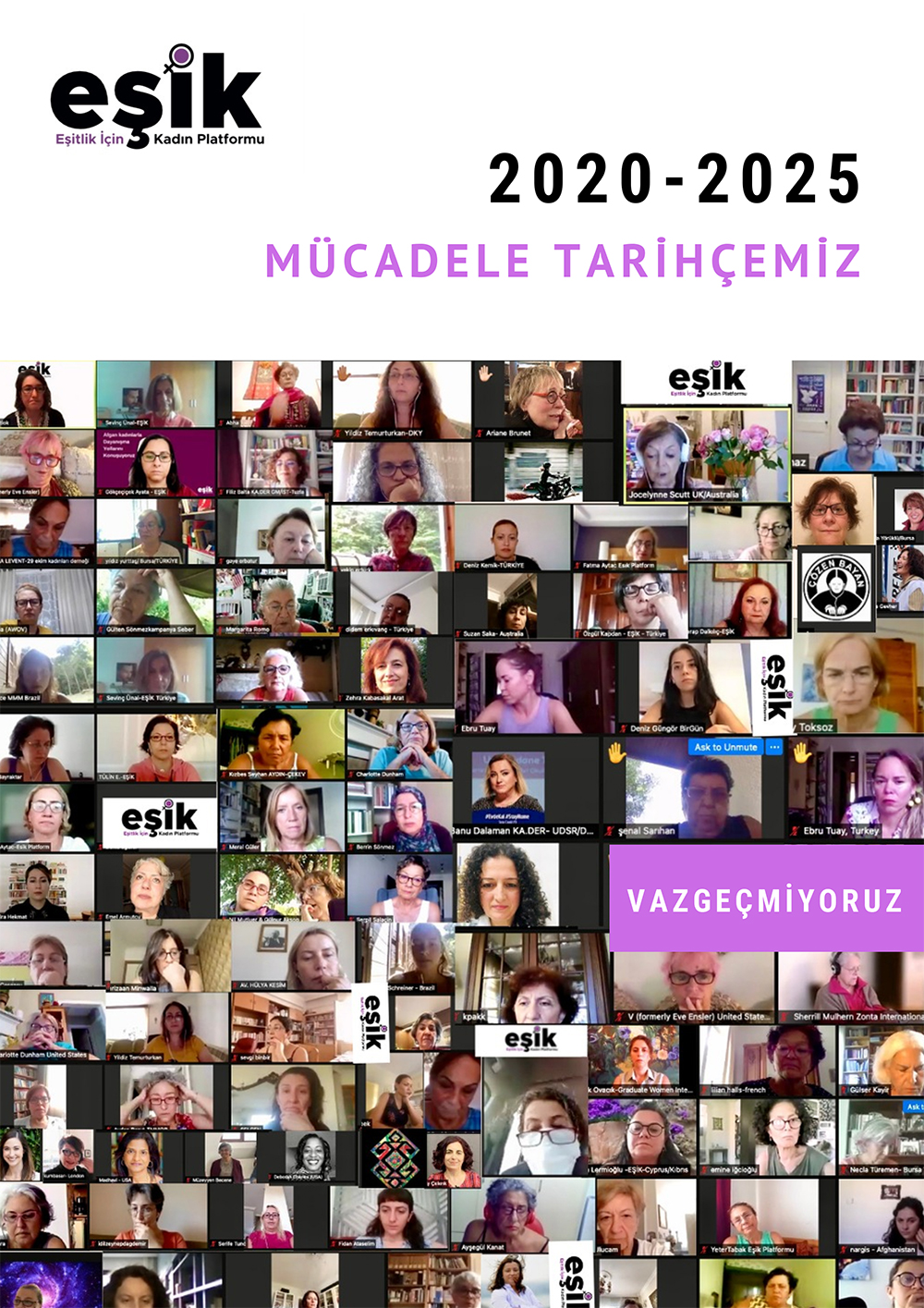
On July 15, 2026, the Women's Platform for Equality, Türkiye (EŞİK) held an international online meeting addressing the Taliban’s "gender apartheid" regime in Afghanistan, as well as the experience of the People's Tribunal for Women of Afghanistan. The meeting recalled EŞİK's call of "We do not recognize the Taliban, nor do we recognize those who recognize the Taliban," which was made after the US, following its twenty-year occupation, withdrew from Afghanistan on August 15, 2021 and handed the country over to the Taliban on a silver platter. The meeting's main speakers were Afghan human rights advocates Shaharzad Akbar and constitutional law scholar Ghizaal Haress.
Sociologist and EŞİK volunteer Özlem Altıok, who served as facilitator, opened the meeting by saying, "The situation facing women and girls in Afghanistan today is the greatest crisis for women's rights in the world, and its effects are felt both in the region and globally." Altıok recalled that EŞİK had taken a clear stance against the regime immediately after the Taliban's return to power, through a statement issued on August 18, 2021, and that it had maintained uninterrupted solidarity with Afghan women ever since – organizing numerous international solidarity meetings and campaigns, taking initiatives at the United Nations, and advocating for the regime in Afghanistan to be recognized as a "gender apartheid" that institutionalizes discrimination and completely excludes women from public life.
Altıok noted that the escalating rights violations sustained by the Taliban regime have brought about the questioning of women's and girls' most basic human rights – including their rights to education and work — in Turkey and other countries as well, and she emphasized the vital importance of the struggle against the Taliban regime and against talibanization.
"The Taliban regime must not be normalized"
Shaharzad Akbar, Director of the Afghan human rights organization Rawadari, emphasized that the international community's trivialization of the Taliban's systematic oppression of women and girls, and the normalization of diplomatic relations with it, are unacceptable. Noting that the Taliban's policies aimed at erasing women from public life do not constitute isolated rights violations but rather a comprehensive regime of oppression, Akbar stated that no state should recognize the Taliban administration as a legitimate government.
Akbar described how the People's Tribunal for Women of Afghanistan, held in Madrid on October 8-10, 2025, was established to center the voices of women and girls who have suffered systematic human rights violations under Taliban rule. She stated that rather than waiting for the international community and official justice mechanisms to act, they sought to make visible Afghan women's demand for justice and accountability, and emphasized that one of the Tribunal's most important principles was that the testimonies of women who had suffered grave violations – such as torture, arbitrary detention, enforced disappearance, and the denial of the right to education and work – be voiced by the women themselves.
Stating that the Tribunal also represents a powerful objection to the Taliban regime's growing normalization on the international stage, Akbar said that the normalization of relations with the Taliban by many governments, including Türkiye’s, under the guise of "pragmatic engagement," renders invisible the severe rights violations experienced by Afghan women.
As a striking example of this contradiction, Akbar pointed to the fact that the Netherlands and Germany – among the states that have invoked international legal mechanisms over the Taliban's systematic discrimination against women – were among the fifteen European countries that recently hosted Taliban representatives in Brussels. She emphasized that this inconsistency between the principles the international community claims to uphold on women's rights and its diplomatic practices is unacceptable.
"The Taliban is committing crimes against humanity."
Noting her own role as a judge on the People's Tribunal on Afghanistan Women, constitutional law scholar Ghizaal Haress emphasized that although the Tribunal's ruling is not legally binding, it constitutes an authoritative record grounded in international law, survivor testimonies, and reports from the UN and civil society. The Tribunal ruled that the bans the Taliban has imposed since 2021 in areas such as education, employment, movement, and dress are not independent of one another but constitute a coordinated, deliberate, and systematic state-level policy, and that this amounts to a crime against humanity in the form of gender persecution under Article 7 of the Rome Statute.
Haress reported that the Tribunal, relying on evidence, rejected the Taliban's claim that these practices are justified by Islamic law or Afghan culture. She also noted that gender-based discrimination bears resemblance to the apartheid regime in South Africa, but that a gap exists in international law because apartheid is currently defined only on a racial basis – and that the Tribunal therefore called on the UN and member states to also codify gender-based discrimination as a crime against humanity.
Continuing her remarks, Haress addressed the significance of the arrest warrants issued by the International Criminal Court (ICC) in 2025 against Taliban leader Mullah Hibatullah Akhundzada and Chief Justice Abdul Hakim Haqqani on charges of persecution on gender grounds (under Article 7 of the Rome Statute). However, she noted that enforcing this ruling depends on the suspects traveling to a third country within the ICC's jurisdiction, and that – as seen in the cases of Assad, Putin, and Netanyahu – such arrests are practically difficult to achieve. In addition, she drew attention to the process initiated by Germany, the Netherlands, Canada, and Australia under the CEDAW Convention, which, following a six-month arbitration phase, could be brought before the International Court of Justice (ICJ). She emphasized that if this case proceeds, it would be the first case brought to the ICJ on the basis of CEDAW, and that – by holding the Afghan state itself directly accountable rather than individuals – it could create pressure for systemic reform. Haress added that while the ICC and ICJ processes are complementary, the fact that the very states pursuing these cases are simultaneously engaging in diplomatic contact with the Taliban in venues such as Brussels constitutes a serious contradiction that grants the Taliban a form of de factolegitimacy.
The meeting also raised the case of Sıdıka, a Turkmen girl who has been imprisoned for nearly two years for resisting being married off at the age of 12 to a 65-year-old man in payment of her father's debt. As illustrated by Sıdıka's case, it was emphasized that forced and early marriages are on the rise in Afghanistan, where the population lives in deep poverty, and that this constitutes a major problem for girls.
The meeting, which recalled EŞİK's pledge that "we will not give up our lives, our rights, our dreams," noted that Afghan women likewise refuse to give these up. The two-hour meeting concluded with a call to stand with Afghan women, who for five years have continued – even under the harshest conditions of oppression – to pursue education, work, resist, and defend their rights, in their struggle for justice, freedom, and equality; and to build global feminist solidarity toward the recognition of gender-based persecution as a crime against humanity under international law and toward holding those responsible to account.
EŞİK's meeting with women's rights advocates from Afghanistan addressed the fight against the normalization of the Taliban
On July 15, 2026, the Women's Platform for Equality, Türkiye (EŞİK) held an international online meeting addressing the Taliban’s "gender apartheid" regime in Afghanistan, as well as the experience of the People's Tribunal for Women of Afghanistan. The meeting recalled EŞİK's call of "We do not recognize the Taliban, nor do we recognize those who recognize the Taliban," which was made after the US, following its twenty-year occupation, withdrew from Afghanistan on August 15, 2021 and handed the country over to the Taliban on a silver platter. The meeting's main speakers were Afghan human rights advocates Shaharzad Akbar and constitutional law scholar Ghizaal Haress.
Sociologist and EŞİK volunteer Özlem Altıok, who served as facilitator, opened the meeting by saying, "The situation facing women and girls in Afghanistan today is the greatest crisis for women's rights in the world, and its effects are felt both in the region and globally." Altıok recalled that EŞİK had taken a clear stance against the regime immediately after the Taliban's return to power, through a statement issued on August 18, 2021, and that it had maintained uninterrupted solidarity with Afghan women ever since – organizing numerous international solidarity meetings and campaigns, taking initiatives at the United Nations, and advocating for the regime in Afghanistan to be recognized as a "gender apartheid" that institutionalizes discrimination and completely excludes women from public life.
Altıok noted that the escalating rights violations sustained by the Taliban regime have brought about the questioning of women's and girls' most basic human rights – including their rights to education and work — in Turkey and other countries as well, and she emphasized the vital importance of the struggle against the Taliban regime and against talibanization.
"The Taliban regime must not be normalized"
Shaharzad Akbar, Director of the Afghan human rights organization Rawadari, emphasized that the international community's trivialization of the Taliban's systematic oppression of women and girls, and the normalization of diplomatic relations with it, are unacceptable. Noting that the Taliban's policies aimed at erasing women from public life do not constitute isolated rights violations but rather a comprehensive regime of oppression, Akbar stated that no state should recognize the Taliban administration as a legitimate government.
Akbar described how the People's Tribunal for Women of Afghanistan, held in Madrid on October 8-10, 2025, was established to center the voices of women and girls who have suffered systematic human rights violations under Taliban rule. She stated that rather than waiting for the international community and official justice mechanisms to act, they sought to make visible Afghan women's demand for justice and accountability, and emphasized that one of the Tribunal's most important principles was that the testimonies of women who had suffered grave violations – such as torture, arbitrary detention, enforced disappearance, and the denial of the right to education and work – be voiced by the women themselves.
Stating that the Tribunal also represents a powerful objection to the Taliban regime's growing normalization on the international stage, Akbar said that the normalization of relations with the Taliban by many governments, including Türkiye’s, under the guise of "pragmatic engagement," renders invisible the severe rights violations experienced by Afghan women.
As a striking example of this contradiction, Akbar pointed to the fact that the Netherlands and Germany – among the states that have invoked international legal mechanisms over the Taliban's systematic discrimination against women – were among the fifteen European countries that recently hosted Taliban representatives in Brussels. She emphasized that this inconsistency between the principles the international community claims to uphold on women's rights and its diplomatic practices is unacceptable.
"The Taliban is committing crimes against humanity."
Noting her own role as a judge on the People's Tribunal on Afghanistan Women, constitutional law scholar Ghizaal Haress emphasized that although the Tribunal's ruling is not legally binding, it constitutes an authoritative record grounded in international law, survivor testimonies, and reports from the UN and civil society. The Tribunal ruled that the bans the Taliban has imposed since 2021 in areas such as education, employment, movement, and dress are not independent of one another but constitute a coordinated, deliberate, and systematic state-level policy, and that this amounts to a crime against humanity in the form of gender persecution under Article 7 of the Rome Statute.
Haress reported that the Tribunal, relying on evidence, rejected the Taliban's claim that these practices are justified by Islamic law or Afghan culture. She also noted that gender-based discrimination bears resemblance to the apartheid regime in South Africa, but that a gap exists in international law because apartheid is currently defined only on a racial basis – and that the Tribunal therefore called on the UN and member states to also codify gender-based discrimination as a crime against humanity.
Continuing her remarks, Haress addressed the significance of the arrest warrants issued by the International Criminal Court (ICC) in 2025 against Taliban leader Mullah Hibatullah Akhundzada and Chief Justice Abdul Hakim Haqqani on charges of persecution on gender grounds (under Article 7 of the Rome Statute). However, she noted that enforcing this ruling depends on the suspects traveling to a third country within the ICC's jurisdiction, and that – as seen in the cases of Assad, Putin, and Netanyahu – such arrests are practically difficult to achieve. In addition, she drew attention to the process initiated by Germany, the Netherlands, Canada, and Australia under the CEDAW Convention, which, following a six-month arbitration phase, could be brought before the International Court of Justice (ICJ). She emphasized that if this case proceeds, it would be the first case brought to the ICJ on the basis of CEDAW, and that – by holding the Afghan state itself directly accountable rather than individuals – it could create pressure for systemic reform. Haress added that while the ICC and ICJ processes are complementary, the fact that the very states pursuing these cases are simultaneously engaging in diplomatic contact with the Taliban in venues such as Brussels constitutes a serious contradiction that grants the Taliban a form of de factolegitimacy.
The meeting also raised the case of Sıdıka, a Turkmen girl who has been imprisoned for nearly two years for resisting being married off at the age of 12 to a 65-year-old man in payment of her father's debt. As illustrated by Sıdıka's case, it was emphasized that forced and early marriages are on the rise in Afghanistan, where the population lives in deep poverty, and that this constitutes a major problem for girls.
The meeting, which recalled EŞİK's pledge that "we will not give up our lives, our rights, our dreams," noted that Afghan women likewise refuse to give these up. The two-hour meeting concluded with a call to stand with Afghan women, who for five years have continued – even under the harshest conditions of oppression – to pursue education, work, resist, and defend their rights, in their struggle for justice, freedom, and equality; and to build global feminist solidarity toward the recognition of gender-based persecution as a crime against humanity under international law and toward holding those responsible to account.
The Women's Platform for Equality, Türkiye
Eşitlik İçin Kadın Platformu (EŞİK)
July 17, 2026
www.esik.org.tr/iletisim@esikplatform.net
Video of the People’s Tribunal for Women of Afghanistan: https://www.youtube.com/watch?v=kHCB82jHIVY
Some of EŞİK’s statements and actions since 2021:
https://esikplatform.net/en/category/english/74732/the-taliban-which-completely-banned-girls-education-after-primary-school-has-now-also-made-slavery-official. (January 30, 2026)
https://esikplatform.net/en/category/english/74263/the-world-forgot-women-and-children-living-under-taliban-oppression-in-afghanistan-for-3-years (August 15, 2024)
https://esikplatform.net/en/category/basin-aciklamalari/74159/the-afghanistan-report-prepared-by-special-coordinator-f.-sinirlioglu-and-presented-to-the-un-security-council-ignores-gender-apartheid (December 5, 2023)
https://esikplatform.net/en/category/basin-aciklamalari/74129/taliban-s-oppression-of-women-and-girls-in-afghanistan-constitutes-gender-based-persecution-and-amounts-to-a-regime-of-gender-apartheid. (August 15, 2023)
https://esikplatform.net/kategori/etkinlikler/72164/afgan-kadinlarla-dayanismak-icin-bulustuk-hicbir-ulke-taliban-yonetimini-tanimamali (August 20, 2021)